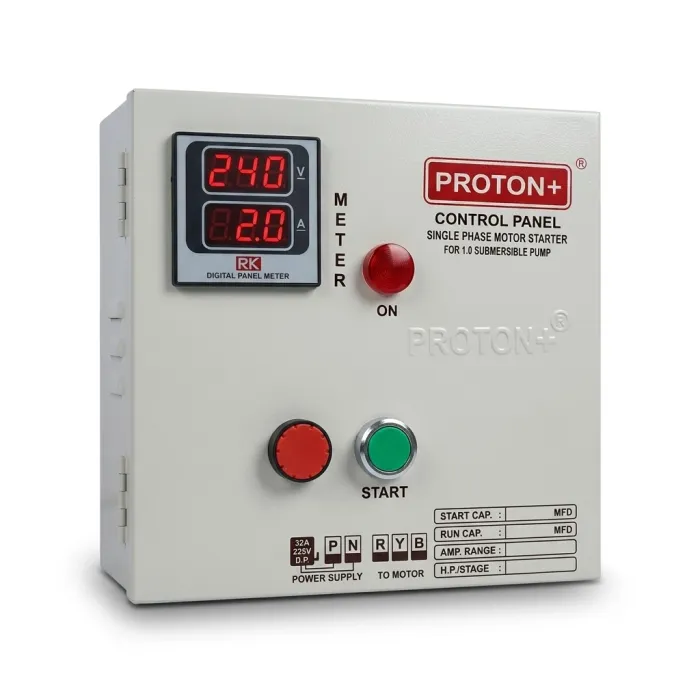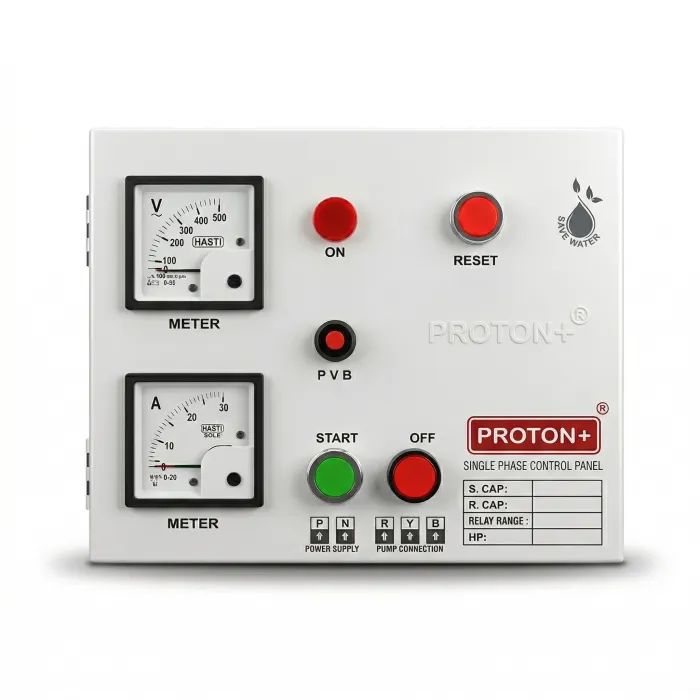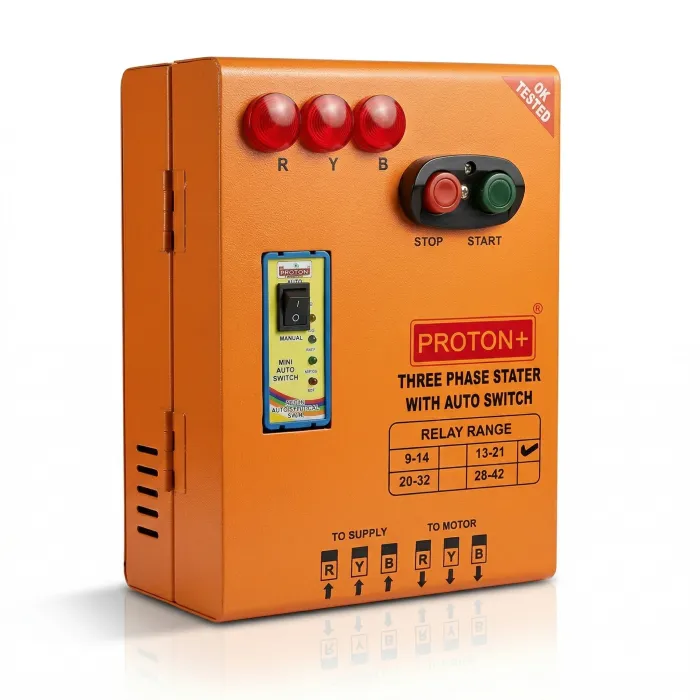
A burnt submersible pump motor is one of the most expensive and frustrating problems faced by farmers, housing societies, and building managers across India. Motor rewinding costs anywhere from ₹2,000 to ₹15,000 depending on HP — and repeated burning permanently degrades winding quality. The good news: most submersible pump motor failures are completely preventable with the right control panel and protection features.
In this guide, Jay Proton Industries — a manufacturer of submersible pump control panels — explains the six main causes of motor burnout and the specific protection features that prevent each one.
Why Do Submersible Pump Motors Burn Out?
Understanding the root cause is the first step to prevention. Here are the most common failure modes seen in Indian installations:
| Cause | What Happens | Frequency |
|---|---|---|
| Dry Run | Pump runs without water — motor overheats rapidly within minutes | Very Common |
| Low / High Voltage | Excess current drawn at low voltage; insulation stress at high voltage | Very Common |
| Single Phasing (3-phase) | One supply phase drops — remaining windings carry 1.7× rated current | Common |
| Overload | Motor runs beyond rated HP due to choked impeller or wrong sizing | Common |
| Frequent Starting | Repeated DOL starts without adequate cooling interval between starts | Moderate |
| Water Ingress at Cable | Moisture enters motor windings through damaged cable joints | Less Common |
Protection #1: Dry Run Protection
Dry run is the single biggest killer of submersible pump motors in India — especially in borewells that run out of water during summer months. A dry run protection panel detects when the pump is running without water (through current sensing or float switch input) and automatically cuts power before the motor overheats.
Protection #2: Voltage Protection (Under/Over Voltage Cutoff)
India's rural power supply is notorious for voltage fluctuations — dropping as low as 160V in some areas or spiking above 260V during off-peak hours. Both extremes are harmful:
- Low voltage: The motor draws more current to maintain torque, causing winding overheating
- High voltage: Accelerates insulation breakdown and causes capacitor failure in single-phase motors
A good control panel includes an automatic voltage cutoff that disconnects the motor when supply voltage falls outside the safe range (typically 180V–260V for single phase systems). The panel reconnects automatically when voltage stabilises.
Protection #3: Thermal Overload Protection
Every submersible pump motor has a rated Full Load Ampere (FLA) on its nameplate. If the pump impeller is choked, the delivery pipe is blocked, or the motor is undersized for the application, current rises above rated value. A thermal overload relay senses this excess current and trips the circuit before winding temperature reaches the damage threshold.
Always ensure the overload relay in your panel is set to match the motor's nameplate FLA — not just the approximate HP rating. A 1HP motor and a 1.5HP motor have different FLA values even if they look identical.
Protection #4: Single Phasing Prevention (3-Phase Motors)
For three-phase submersible pumps, single phasing is the most catastrophic fault. When one supply phase is lost:
- The motor continues to run on two phases — it does not stop automatically
- Current in the remaining windings rises to 1.7–2× rated value
- Winding temperature spikes sharply — the motor can burn within 2–5 minutes
A Single Phase Preventer (SPP) or Electronic Three Phase Preventer detects phase loss, phase reversal, and phase imbalance — and immediately trips the contactor before any damage occurs. This is a non-negotiable protection component for every three-phase pump panel.
Protection #5: Auto-Reset with Time Delay
After any protection trip, a well-designed panel offers automatic restart with a configurable time delay. This prevents the motor from immediately restarting into the same fault condition and allows:
- Motor windings to cool down after an overload trip
- Borewell water level to recover after a dry run trip
- Supply voltage to stabilise after a voltage trip
Which Panel is Right for Your Pump?
| Application | Recommended Panel | Key Protections |
|---|---|---|
| Single phase borewell (up to 2HP) | CH Type / MCB Type Panel | Overload, voltage cutoff |
| Single phase submersible (digital) | Digital Suraksha / AGNI SR-72 | Dry run, voltage, overload, auto-restart |
| Three phase submersible (3–15HP) | Three Phase ECO / MU-2 Panel | Single phasing, overload, dry run |
| Open well / Surface pump | Single Phase Openwell Panel | Overload, float switch dry run |
Quick Maintenance Checklist
- Check water level before starting — Never start a borewell pump when water level is unknown
- Allow 5 minutes between starts — Each DOL start is equivalent to running the motor at 5–7× rated current for 2–3 seconds
- Test supply voltage monthly — Use a digital voltmeter at the panel input terminals before seasonal use
- Trip-and-reset overload relay annually — Confirm the protection is functional, especially before summer irrigation season
- Inspect cable entry points — Water ingress at cable joints near the pump is a common cause of winding failure
- Use IS-certified panels — Panels conforming to IS 4237 / IS 13947 provide tested, reliable protection components
Not Sure Which Panel Protects Your Motor?
Tell us your motor HP, number of phases, and application — our engineers will recommend the exact protection panel for your installation, free of charge.
Get Free Recommendation