Choosing between a star-delta starter and a DOL starter is one of the most common decisions for anyone installing or upgrading motor control equipment in India — whether for an agricultural pump set, an industrial compressor, or a water supply motor. Get it wrong and you risk motor burnouts, voltage dips, or unnecessarily high capital cost.
This article gives you a clear, engineer-verified comparison of both technologies so you can make the right choice for your specific application.
Quick Comparison: Star Delta vs DOL Starter
| Parameter | DOL Starter | Star-Delta Starter |
|---|---|---|
| Motor HP Range | Up to 10 HP (7.5 kW) | 10 HP (7.5 kW) and above |
| Starting Current | 6–8× Full Load Current | 2–2.5× Full Load Current |
| Starting Torque | 100% (full torque) | ~33% (reduced torque) |
| Voltage at Start | Full (415V) | Reduced (240V in star) |
| Number of Contactors | 1 main contactor | 3 contactors (main, star, delta) |
| Cost | Lower (₹800–₹3,500) | Higher (₹3,500–₹12,000+) |
| Wiring Complexity | Simple | Moderate to complex |
| Motor Terminal Access | 3-terminal connection | All 6 motor terminals needed |
| Supply Network Impact | High voltage dip | Minimal voltage dip |
| Maintenance | Easy | Moderate |
What is a DOL Starter?
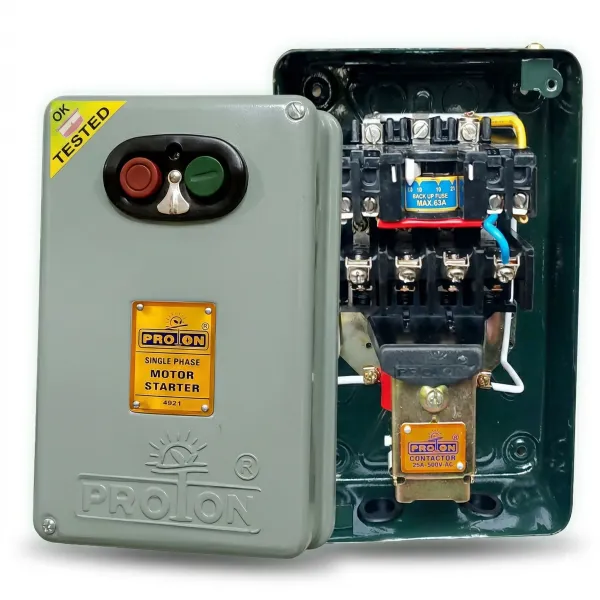
A Direct-On-Line (DOL) starter connects the motor directly to the full 415V three-phase supply at the moment of starting. It uses a single main contactor and a thermal overload relay. When you press Start, the motor receives full voltage instantly and accelerates to rated speed.
The advantage is simplicity and full starting torque. The drawback is the high inrush current — 6 to 8 times the full-load current — which stresses the windings, causes a momentary voltage dip on the supply line, and can trip MCBs or affect sensitive equipment nearby.
For small motors up to 7.5 kW, this current spike is acceptable. For larger motors, it is not. Read our detailed guide: What is a DOL Starter?
What is a Star-Delta Starter?
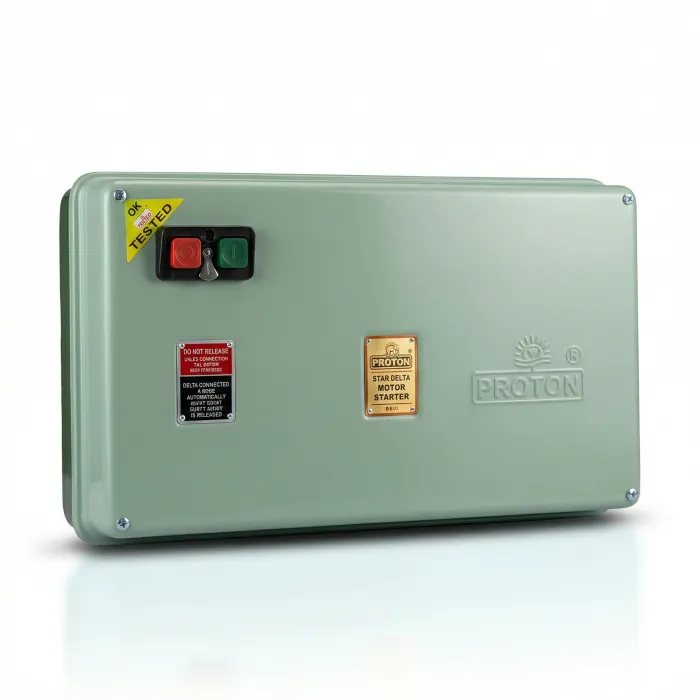
A star-delta starter reduces the starting current by first connecting the motor windings in a star (Y) configuration, which applies only ~58% of the line voltage to each winding. After a preset time (typically 5–15 seconds), it switches to delta (Δ) configuration for normal running at full voltage.
This two-step starting process reduces starting current to approximately one-third of the DOL value — from 6–8× FLC down to 2–2.5× FLC. The trade-off is that starting torque is also reduced to one-third, which is sufficient for centrifugal loads (pumps, fans, blowers) that start unloaded or under light load.
Starting Current Comparison in Detail
To illustrate the difference concretely, consider a 15 kW (20 HP) motor with a full-load current of 30A:
| Starter Type | Starting Current | Peak Power Demand |
|---|---|---|
| DOL | ~210A (7× FLC) | ~148 kVA |
| Star-Delta | ~70A (2.3× FLC) | ~49 kVA |
The difference is dramatic. On a farm with multiple motors or a weak rural supply line, a DOL-started 15 kW motor would cause visible flickering of lights and potential tripping of RCCB/MCBs. A star-delta starter eliminates this issue entirely.
Starting Torque: A Critical Consideration
Star-delta starters deliver only 33% of the motor's rated torque during the star phase. This is perfectly adequate for:
- Centrifugal pumps (water, irrigation, borewell)
- Fans and blowers
- Compressors that start unloaded
However, star-delta starters are NOT suitable for loads that require high starting torque, such as:
- Loaded conveyors and belt feeders
- Mixers and agitators with full load at start
- Crushers and mills
For high-torque loads above 7.5 kW, a soft starter or VFD (Variable Frequency Drive) is the correct solution.
When to Choose a DOL Starter
- Motor rating: up to 7.5 kW (10 HP)
- Supply: robust grid or DG set with adequate capacity
- Load: centrifugal pump, fan, small compressor
- Budget: minimum capital investment required
- Maintenance capability: simple troubleshooting preferred
When to Choose a Star-Delta Starter
- Motor rating: above 7.5 kW (10 HP)
- Supply: rural or weak grid where voltage dip is a problem
- Load: centrifugal pump, large fan, unloaded compressor
- Multiple motors on the same feeder — minimise cross-interference
- All 6 motor terminals are accessible
Cost Comparison
The cost difference between DOL and star-delta starters is significant. A star-delta panel requires three contactors, a timer relay, additional wiring, and a larger enclosure — roughly 2.5–4× the cost of an equivalent DOL panel. For motors below 7.5 kW, this extra investment is rarely justified.
For motors above 7.5 kW, the star-delta cost premium is easily offset by reduced strain on the supply infrastructure, lower peak power demand charges (in metered commercial/industrial connections), and longer motor life.
IS / IEC Standards
Both DOL and star-delta starters should comply with IS 13947 / IEC 60947. Ensure contactors are rated for AC3 duty (squirrel cage motor switching), and the overload relay is set to the motor's rated current. Non-certified starters often use under-rated contactors that overheat and fail prematurely.
Final Verdict
- Motor ≤ 7.5 kW → Use a DOL Starter
- Motor 7.5–75 kW, centrifugal load → Use a Star-Delta Starter
- Motor > 75 kW or high-torque load → Use a Soft Starter or VFD
Not Sure Which Starter You Need?
Send us your motor nameplate details — HP, voltage, FLC — and our team will recommend the right starter with a competitive price quote.